Big plans today for Frostbite Brewing. There are currently two batches of beer fermenting, with the "Whiskey Romeo's Brown Ale" to be bottled and the All-Amarillo IPA ready to be transferred to secondary fermenation and dry hopped with two ounces of amarillo hops. Plus we will be brewing an 80 Shilling Scottish Ale. It is a good thing that family will be coming over to help out today!
The history of "shilling" catergories of beers in Scotland relates to the price charged per barrel during the 19th century with the stronger and better quality beers costing more. Beer styles were also referred to by strength according to the following names:
Light (60/-) under 3.5% ABV
Heavy (70/-) between 3.5% - 4.0% ABV
Export (80/-) between 4.0 % - 5.5% ABV
Wee heavy (90/-) over 6.0% ABV
The Beer Judge Certification Program (BJCP) guidlines for a Scottish Export 80/- are as follows:
Aroma: Low to medium malty sweetness, sometimes accentuated by low to moderate kettle caramelization. Some examples have a low hop aroma, light fruitiness, low diacetyl, and/or a low to moderate peaty aroma (all are optional). The peaty aroma is sometimes perceived as earthy, smoky or very lightly roasted.
Appearance: Deep amber to dark copper. Usually very clear due to long, cool fermentations. Low to moderate, creamy off-white to light tan-colored head.
Flavor: Malt is the primary flavor, but isn’t overly strong. The initial malty sweetness is usually accentuated by a low to moderate kettle caramelization, and is sometimes accompanied by a low diacetyl component. Fruity esters may be moderate to none. Hop bitterness is low to moderate, but the balance will always be towards the malt (although not always by much). Hop flavor is low to none. A low to moderate peaty character is optional, and may be perceived as earthy or smoky. Generally has a grainy, dry finish due to small amounts of unmalted roasted barley.
Mouthfeel: Medium-low to medium body. Low to moderate carbonation. Sometimes a bit creamy, but often quite dry due to use of roasted barley.
Overall Impression: Cleanly malty with a drying finish, perhaps a few esters, and on occasion a faint bit of peaty earthiness (smoke). Most beers finish fairly dry considering their relatively sweet palate, and as such have a different balance than strong Scotch ales.
Comments: The malt-hop balance is slightly to moderately tilted towards the malt side. Any caramelization comes from kettle caramelization and not caramel malt (and is sometimes confused with diacetyl). Although unusual, any smoked character is yeast- or water-derived and not from the use of peat-smoked malts. Use of peat-smoked malt to replicate the peaty character should be restrained; overly smoky beers should be entered in the Other Smoked Beer category (22B) rather than here.
History: Traditional Scottish session beers reflecting the indigenous ingredients (water, malt), with less hops than their English counterparts (due to the need to import them). Long, cool fermentations are traditionally used in Scottish brewing.
Ingredients: Scottish or English pale base malt. Small amounts of roasted barley add color and flavor, and lend a dry, slightly roasty finish. English hops. Clean, relatively un-attenuative ale yeast. Some commercial brewers add small amounts of crystal, amber, or wheat malts, and adjuncts such as sugar. The optional peaty, earthy and/or smoky character comes from the traditional yeast and from the local malt and water rather than using smoked malts.
Vital Statistics: OG: 1.040–1.054 IBUs:15–30 FG:1.010–1.016 SRM:9– 7 ABV:3.9–5.0%
Commercial Examples: Orkney Dark Island, Caledonian 80/- Export Ale, Belhaven 80/- (Belhaven Scottish Ale in the US), Southampton 80 Shilling, Broughton Exciseman’s 80/-, Belhaven St. Andrews Ale, McEwan's Export (IPA), Inveralmond Lia Fail, Broughton Merlin’s Ale, Arran Dark
Saturday, November 28, 2009

Sunday, November 15, 2009
Amarillo IPA Brew Day
This IPA recipe features usage of Amarillo and Simcoe hops. Amarillo imparts a citrus aroma and flavor similar to a grapefruit/mango/peach. Simcoe gives more of a floral and pine-like aroma and flavor. The recipe uses 5 ounces of Amarillo hops and 1 ounce of Simcoe.

Here is the recipe:
6.0 lbs of Light Liquid Malt Extract
2.0 lbs of Light Dry Malt Extract
1.0 lbs of 20L Caramel Malt
0.5 lbs of Cara-Pils Malt
Hops
1.o oz of Amarillo at 60 min
1.o oz of Amarillo at 30 min
1.o oz of Amarillo at 15 min
1.o oz of Amarillo at 2 min
1.o oz of Amarillo (dry hopped into secondary)
1.0 oz of Simcoe (dry hopped into secondary)
Yeast
White Labs California Ale Yeast - WLP001
Saturday, October 31, 2009
Cider Beer and Brown Ale Update
Happy Halloween everyone! I've got some extra time waiting for the trick or treaters so I thought I would post a quick update as to what is happening with the brews. Last Sunday (October 25, 2009) I moved the Cider Beer and Brown Ale over to their secondary carboys. Here is an update on each beer:
Brown Ale: The Brown Ale is the free wort I got from Surly on October 10. Fermentation is still pretty active with beer, likely due to the high gravity their is a lot of sugar for the yeast to get after. Once I transferred to the secondary I also added the whiskey soaked oak cubes to the beer. Here is a picture of the oak cubes sitting in the carboy:

At some point I need to decide on a name for this beer. My brother-in-law James and were discussing it the other day and he came up with "Whisky Richard's Brown Ale". I think it may stick. I have no idea when I will bottle this one due to the on-going fermentation. I may let this one may ferment for months.
Cider Beer: As for the Cider Beer, fermentation has slowed considerably since racking to the secondary. I did add three cinnamon sticks to the carboy as well. This cider is looking pretty murky at this point, most ciders are near clear or light bodied but this is looking like sludge at this point. The cider I bought wasn't light or clear and was near this color, so I'm not too worried at this point. I intend on bottling this one sometime next week. Any thoughts on a name for the cider beer?
Here is a pic of the Whisky Richard's Brown Ale on the left and the Cider Beer on the right.

Tuesday, October 27, 2009
Darkness Day
On Saturday I attended Darkness Day at the Surly Brewing Company. Darkness is the name of Surly's Russian Imperial Stout beer. A Russian Imperial Stout is a very strong dark ale which alcohol by volume often in excess of 10%. The history of Russian Imperial Stouts can be traced back to 1796 and Catherine the Great of Russia's fondness for the beer style. Catherine had contracted directly with the Courage Anchor Brewery and John Courage Brewery of England to produce the beer style directly for her and her court.
Russian Imperial Stouts are somewhat unique in the time that they take to ferment and condition. Most beers will ferment and condition in a matter of weeks. Imperial stouts can take up to a year to ferment and years to condition. Like a good wine, Russian Imperial Stouts get better with age.
Surly's Darkness is released one day per year at a special event at the brewery. The first 800 people were given a wrist band that allowed you to buy up to 6 bottles at $18 each. This year they are also releasing 2500 bottles to the local liquor stores next week. We arrived at 9:30 a.m. and were able to get wrist bands but I was told that they ran out of wristbands before the doors even opened at 12:00 p.m.! Here's a picture of the line going for as far as you can see at about 11:00 a.m.
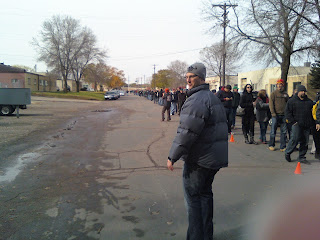
I would imagine that for many the Russian Imperial Stout is an acquired taste as it is the antithesis of the traditional American lager. The taste of Russian Imperials is heavy on chocolate, coffee, and roasted malt flavors. Some Russian Imperials do not manage to hide the alcohol content and have a slight alcohol burn to them. Often Russian Imperials will also ferment in fruit, wood, or some other flavor to help balance it out. The good ones, such as Surly's Darkness, balance the sweetness, bitterness, and mask the alcohol content so well that it tastes more like a dessert than a beer. The longer that these bottles sit, the better that the flavors balance out. I plan to cellar these beers for as long as possible but I don't know how long I will be able to hold out!
Monday, October 19, 2009
Cider Beer Brew Day
4 gallons of fresh pressed cider
1 gallon of water
1 lb Light Malt Extract
1 lb Amber Malt Extract
8 oz Caramel 60 Malt
4 oz Flaked Oats
1 oz Torrified Wheat
8 oz Fuggle Hops
Wyeast Apple Cider Yeast

I also plan on adding some cinnamon sticks during the secondary fermentation process. I was thinking I would add between 2-5 sticks, but I don't want it to be overpowered with cinnamon. either. Original Gravity was 1.060, so depending on how well it ferments it will finish around 5.5%-6.5% alcohol by volume. Most cider recipes call for extended fermentation over several months, but I intend on letting it ferment for less than one month. I also don't want to wait several months to give this a try!

Saturday, October 17, 2009
Surly Wort Update
The oak cubes are soaking in whisky right now. I ended up getting Windsor Canadian Whisky, primarily because it was $3.50 for a fifth of a pint. I'm a bit skeptical as to how the whisky oak barrel aging will work, but since this is free wort I thought I would give it a shot.

P.S. Did anyone know there is a difference between "whisky" and "whiskey"? Apparently whiskey is used primarily in Canada, Ireland, and Scotland, while "whiskey" is used in most other locations including the United States.
Tuesday, October 13, 2009
Fermentation Gone Wild!
Lately I have been monitoring the fermentation progress with the free wort that I got from Surly this past weekend. You can usually notice the fermentation process within 24 hours, but this one didn't become active until yesterday evening (48 hours later). Since then it has been fermenting like crazy!

Fermenation in beer is the process of the yeast converting the glucose (sugar) into alcohol and carbon dioxide (C02). As the fermentation process takes course, the C02 needs to escape the fermentation vessel or your risk having it explode! That is where an airlock comes into place.
An airlock is a small device attached to the fermentation vessel that is filled with water to create a water trap. The airlock allows the C02 to escape through the water without exposing the fermenting wort to outside air. This prevents outside contamination from outside bacteria and wild yeasts.
As you can see in the above picture, the fermentation process on this wort is very active. In fact it was too active. One problem with rapid fermentation is that it can produce bubbles that eventually creep up the vessel and clog the airlock. That is what happened repeatedly when I check on it last night before bed. I then decided to take the airlock off and this is what happened:

The C02 bubbles were out of control! It was like I was in the middle of a high school chemistry experiment gone wrong. I tried cleaning the airlock twice but it got clogged with bubbles again within minutes. So I had to solve this dilemma as I didn't want to leave it off and risk exposure (and a basement full of beer bubbles). I also didn't want to leave the airlock on with it getting clogged and risk it being shot off like a champagne cork or having the vessel explode!
I then remembered the fermentation vessels at Surly Brewing Company. Next to each tank was a garbage can sized plastic bucket filled with water with a tube leading into it from the vessel. This is called a blow off tube. The C02 escapes the fermentation vessel through the tube and is blown into the bucket, again without exposing the beer to outside air. The one thing I remembered about Surly's blow off tubes is that the buckets were bubbling like it was a hot tub!
I then decided that I would need to hone my MacGyver skills and create my own blow off tube. I happened to have a rubber tube laying around that I use for siphoning in an out of the fermentation vessels. I then grabbed a pitcher and filled it with sanitized water and was set. Here is the blow off tube in action:

24 hours later, the pitcher is bubbling, and fermentation is still very active. I guarantee that if I wouldn't have done anything last night I would of had a heck of a mess to clean up.
Crisis averted!
Subscribe to:
Posts (Atom)